
AI Certification Courses to Future-Proof Your Career in 2026

Discover the best free AI certification courses with certificates in 2026. No experience needed. Learn which AI skills employers want and how to get certified fast.
If you are a working professional or a recent graduate trying to figure out where AI fits into your career, you are not alone. The job market is changing fast, and free AI certification courses with certificates are one of the smartest moves you can make right now to stay competitive. Whether you are looking to upskill in your current role, switch careers, or simply make yourself harder to replace, getting certified in AI through online learning gives you a real edge without breaking your budget.
According to ManpowerGroup's 2026 Talent Shortage Survey of more than 39,000 employers across 41 countries, AI skills have now surpassed all other skill categories as the hardest to fill globally. That is not hype. That is a hiring reality you need to pay attention to.
This guide breaks down the best AI certification courses available in 2026, including which ones are free, who they are built for, how long they take, and what AI skills employers actually want to see on your resume.
What Is an AI Certification Course?
An AI certification course is a structured online learning program that teaches you the principles, tools, and applications of artificial intelligence. When you complete one, you receive a shareable certificate or digital badge you can add to your LinkedIn profile or resume.
These programs range from one-hour beginner overviews to multi-month advanced specializations. Some are completely free. Others require a modest monthly subscription or a one-time exam fee. The best ones are developed by Google, IBM, MIT, Harvard, and DeepLearning.AI, and many are available through e-learning platforms such as Coursera, edX, and LinkedIn Learning.
You do not need a computer science degree to get started. Many of the top-rated programs require zero prior experience.
Why AI Skills Matter More Than Ever in 2026
Here is the honest picture: 35% of entry-level job listings now require some form of AI skills, according to the National Association of Colleges and Employers (NACE). At the same time, only 27% of college seniors say AI was meaningfully integrated into their academic programs, according to Handshake's 2026 Graduate Report.
That gap is your opportunity.
The reality for recent graduates is tough. Entry-level job postings have dropped roughly 35% since early 2023, with some tech and data roles down as much as 67%, according to data from Revelio Labs. But graduates who build AI tool proficiency and pursue skills-based credentials are consistently finding more traction in today's hiring market.
For working professionals, the picture is slightly different. The Forbes School16 research shows AI is not a crashing wave wiping out entire jobs overnight. It is a rising tide, gradually reshaping how tasks get done across every department. Sales, marketing, customer success, finance, product, and operations are all being touched. The professionals who learn to work alongside AI tools will be the ones who grow.
The message is the same whether you are 22 or 42: online learning through AI certification is one of the most direct investments you can make in your earning potential right now.
Best Free AI Certification Courses with Certificates in 2026
Google AI Essentials
Best for: Beginners with no technical background
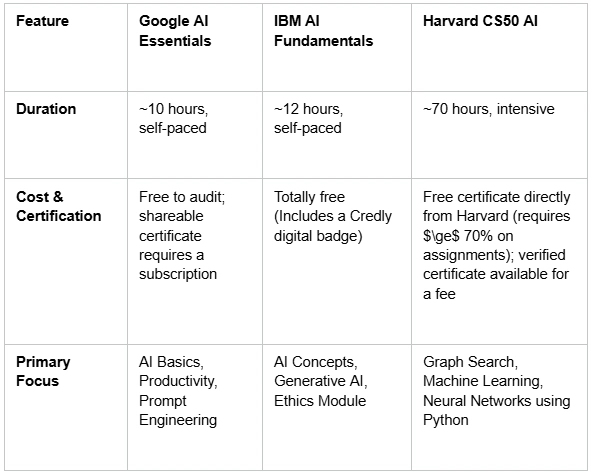
Google AI Essentials is widely considered the gold standard starting point for AI beginners in 2026. It is a five-course specialization covering AI basics, AI-driven productivity, prompt engineering, responsible AI use, and keeping up with AI trends. The whole program takes about 10 hours and is self-paced.
You do not need any technical background. If you can use a smartphone, you can take this course. The certificate is recognized by employers globally and carries real brand weight on a resume.
Cost: Free to audit on Coursera. A shareable certificate requires a Coursera Plus subscription (around $49/month, with a 7-day free trial).
IBM AI Fundamentals (via IBM SkillsBuild)
Best for: Career changers and professionals wanting employer-recognized badges
IBM SkillsBuild offers a free AI Fundamentals learning credential that covers six courses, including AI concepts, generative AI, and an AI Ethics module that is genuinely worth your time. When you finish, IBM issues a Credly digital badge that you can display directly on LinkedIn.
This course is completely free. No credit card required. Registration is simple. It is one of the strongest, truly free options for anyone who wants an employer-recognized starting point without hitting a paywall.
Cost: Free, including the credential.
AI for Everyone by DeepLearning.AI
Best for: Non-technical professionals and managers
Created by Andrew Ng, one of the world's most respected AI educators, AI for Everyone is designed specifically for people who are not developers. You will learn what AI can and cannot realistically do, how to spot AI opportunities in your own organization, and how to think about building a basic AI strategy for your team.
It runs about seven hours and requires no prerequisites. This is a strong choice for professionals in business, finance, HR, or marketing who want to lead smarter conversations about AI at work.
Cost: $24 per month via Coursera Plus.
LinkedIn Learning AI Courses
Best for: Professionals who want career-focused AI training with certificates
LinkedIn Learning has awarded nearly 500,000 professional certificates over the past two and a half years, and generative AI is one of the most popular topics on the platform. The library includes more than 1,500 AI courses covering everything from machine learning in Python to building career resilience in the age of AI.
Many employers and universities provide free LinkedIn Learning memberships to their employees and students. Check with your organization before paying out of pocket.
Cost: Free trial, then $39.99/month. Many access it for free through employers or universities.
Introduction to Generative AI by Google Cloud
Best for: Anyone wanting the fastest possible introduction to generative AI
This is a one-hour course. That is it. You finish it, pass a short assessment, and walk away with a certificate covering what generative AI is, how it works, and what its main applications are. It is not deep, but it is a fast, legitimate credential you can add to your profile while working through longer programs.
Cost: $24 per month via Coursera Plus.
Harvard CS50's Introduction to Artificial Intelligence with Python
Best for: Motivated learners who want a serious technical foundation
If you are a recent computer science graduate or a developer who wants real depth, Harvard's CS50 AI is one of the most respected free university courses available. You will work through graph search algorithms, machine learning, neural networks, and natural language processing, all in Python.
The honest caveat: this is a 70-hour commitment. It is a real university course with real problem sets. But the certificate is free if you score above 70% on all assignments, and Harvard's name carries serious credibility.
Cost: Free certificate directly from Harvard. A verified certificate is available via edX for an additional fee.
Best AI Certification Courses for Career Changers with No Experience
If you are making a full career pivot into AI and do not have a technical background, here are the paths worth considering:
IBM AI Developer Professional Certificate on Coursera is consistently ranked among the best options for career changers. You will work with Watson Studio, IBM Cloud, and Python notebooks in a guided environment. IBM certifications hold up well with enterprise employers. At roughly $200 total on Coursera Plus, the depth and job placement rate (87% within three months, according to NuCamp's 2026 data) make it a strong investment.
Microsoft Azure AI Fundamentals (AI-900) is a non-technical entry-level certification that costs around $99 and takes two to four weeks. It is recognized by enterprise employers across industries and does not require a coding background.
AWS Certified AI Practitioner costs about $100 and takes four to six weeks. With so many companies running on AWS infrastructure, this one has strong practical market value.
LinkedIn Career Essentials in Generative AI is under five hours and completely free. When you finish, the certificate automatically appears on your LinkedIn profile. It is not deep, but it is fast and visible to recruiters.
Best Advanced AI Certifications for Professionals with Experience
MIT Professional Certificate in Machine Learning and Artificial Intelligence
Best for: Senior professionals and data analysts who want MIT credentials
This is the most prestigious option on this list and the most expensive. MIT Professional Education's certificate program covers linear regression, neural networks, deep learning, NLP, and large language model applications. It is designed for professionals with at least three years of technical experience.
To earn the certificate, you complete 16 or more days of qualifying short program courses. Each course costs between $2,500 and $4,700. This is a serious career investment, but the MIT name opens doors that few other credentials can.
Cost: $2,500 to $4,700 per course.
CertNexus Certified Artificial Intelligence Practitioner (CAIP)
Best for: Data scientists moving into AI roles
This five-course series on Coursera prepares you for the industry-recognized CAIP certification exam. It covers business applications of AI, machine learning and deep learning algorithms, and AI ethics. It is designed for intermediate learners who already have some background working with data or programming.
Cost: $20 per month via Coursera. Takes about two months at 10 hours per week.
Harvard Professional Certificate in Computer Science for AI (via edX)
Best for: Aspiring AI engineers and developers
This five-month program combines Harvard's CS50 Introduction to Computer Science with CS50 AI. You will work through algorithms, data structures, intelligent system design, and hands-on projects. It is one of the most respected non-degree credentials for someone building toward an AI engineering career.
Cost: $518 total via edX.
What AI Skills Do Employers Actually Want in 2026?
According to ManpowerGroup's 2026 Talent Shortage Survey, AI Model and Application Development, and AI Literacy now lead the global ranking of hard-to-find skills. Here is what hiring managers are specifically looking for:
Prompt engineering is the practice of writing effective instructions for AI systems such as ChatGPT, Claude, or Gemini. This skill is needed across virtually every role now, from marketing to legal to software development.
AI literacy means understanding what AI can and cannot do, how to evaluate outputs critically, and how to use these tools responsibly. CNBC's reporting on the 2026 NACE employer survey found that even as AI skills grow in importance, communication, critical thinking, and problem-solving remain the top qualities employers want. AI literacy bridges both.
Machine learning basics are increasingly expected for data analysts, product managers, and anyone working with customer data or business intelligence.
Generative AI for specific roles is the next level. Employers now want to see that you can apply AI tools to your specific job function, whether that is generating content, writing code, automating workflows, or analyzing data.
Responsible and ethical AI use is showing up in more job descriptions as companies face regulatory pressure and reputational risk around AI deployment.
Should You Pay for an AI Certification?
This is the honest answer: it depends on your goal.
If you want to signal initiative and build foundational knowledge quickly, start with the free options. IBM SkillsBuild, Google AI Essentials, and LinkedIn's Career Essentials in Generative AI are all legitimate credentials you can have on your profile within a week.
If you are making a serious career pivot or gunning for a technical role, investing in a more rigorous program like the Harvard CS50 AI, IBM AI Developer Professional Certificate, or an AWS or Azure certification gives you demonstrably more substance to talk about in interviews.
The worst move is doing nothing. As CNBC reported, based on 2026 Handshake graduate data, 85% of college seniors now use AI tools regularly, up 31% from two years ago. The window to stand out simply by having AI knowledge is closing. The differentiation now comes from being able to apply it.
How to Choose the Right AI Certification for Your Career
Ask yourself these four questions before you enroll:
What is your experience level? If you have no technical background, start with Google AI Essentials, IBM SkillsBuild, or AI for Everyone. If you have programming experience, consider Harvard's CS50 AI or IBM's AI Developer Professional Certificate.
What is your career goal? Non-technical professionals looking to use AI in their current role should prioritize AI literacy and tool-specific training. Those targeting AI-specific roles should pursue more technical credentials in Python, machine learning, and data science.
How much time can you realistically commit? Courses range from one hour to five months. Be honest about what you will actually finish. A completed one-hour certificate beats an abandoned five-month program every time.
What is your budget? Start free. Most of the best beginner content costs nothing. Once you know the direction you want to go, a targeted investment in a recognized credential will pay for itself quickly.
AI Career Paths Worth Knowing About
Getting certified opens doors to several growing career tracks:
AI Product Manager: Leads teams building AI-powered products, working across technical and business functions. One of the fastest-growing hybrid roles in 2026.
Machine Learning Engineer: Designs, builds, and deploys machine learning models. One of the highest-paid roles in tech.
Data Scientist: Collects, analyzes, and interprets large data sets using AI techniques to drive business decisions.
NLP Engineer: Works with human language data, building systems that understand and generate text and speech. High demand as AI assistants become embedded across industries.
AI Ethics and Governance Specialist: An emerging role as companies and governments wrestle with responsible AI deployment. Strong growth trajectory.
Start Your Online Learning Journey Today
The best time to get certified in AI was two years ago. The second-best time is today.
Whether you have 10 hours or 10 months, there is a free AI certification course that fits your schedule, your budget, and your career goals. The professionals and graduates who take action now, build real skills, and stack credible credentials will be the ones who come out ahead in the next five years of this market.
Head to Coursera, IBM SkillsBuild, edX, or Google's Grow with Google program and start your first course this week. Your future employer is already looking for someone who did.
Frequently Asked Questions
What are the best free AI certification courses with certificates in 2026?
The top truly free options are IBM AI Fundamentals via IBM SkillsBuild, LinkedIn Career Essentials in Generative AI, Google AI Essentials (free to audit on Coursera, certificate requires subscription), Harvard CS50 AI (free certificate if you pass all assignments), and Elements of AI from the University of Helsinki. All are legitimate, recognized credentials you can add to your LinkedIn profile.
What are the best AI certifications for career changers with no experience?
Google AI Essentials, IBM AI Foundations for Everyone, Microsoft Azure AI Fundamentals (AI-900), and LinkedIn Career Essentials in Generative AI all require zero prior experience. For a more comprehensive career pivot, the IBM AI Developer Professional Certificate on Coursera is highly rated for job placement outcomes.
What AI skills do employers want in 2026?
According to ManpowerGroup's 2026 Talent Shortage Survey, AI literacy and AI model application are the top two hardest-to-find skill sets globally. Employers specifically look for prompt engineering, proficiency with generative AI tools, machine learning basics, and responsible AI use, alongside communication, critical thinking, and problem-solving skills.
How long does it take to get an AI certification?
It depends on the program. Google's Introduction to Generative AI takes one hour. Google AI Essentials takes about 10 hours. IBM AI Fundamentals takes around 12 hours. The IBM AI Developer Professional Certificate takes one to three months. Harvard CS50 AI takes approximately 70 hours. MIT's certificate program involves 16 or more days of coursework.
Are free AI certifications actually worth anything?
Yes, especially from reputable providers like Google, IBM, Microsoft, Harvard, and LinkedIn. A free certificate from a recognized organization signals initiative and demonstrates real knowledge. Employers increasingly prioritize verified skills over the cost of the credential. Pair your certification with a practical project or portfolio piece for the strongest impact.
Do I need to know how to code to get an AI certification?
No. Many of the best AI certifications in 2026 require zero coding experience. Google AI Essentials, IBM AI Fundamentals, Microsoft Azure AI-900, AWS AI Practitioner, and LinkedIn Career Essentials in Generative AI are all designed for non-technical learners. If you want a more technical certification later, Python is the most useful programming language to learn first.
Where can I study AI online for free?
You can study AI through free e-learning platforms and resources, including Coursera (audit option), IBM SkillsBuild, Microsoft Learn, Google's Grow with Google program, DeepLearning.AI, edX (audit option), LinkedIn Learning (free trial), Amazon AWS Skill Builder, and Harvard's CS50 program at cs50.harvard.edu.
What is the difference between an AI certificate and an AI certification?
A certificate is a credential earned by completing a course or program, like Google AI Essentials or Harvard CS50 AI. A certification typically refers to a credential earned by passing a proctored exam administered by a third-party organization, like the CertNexus Certified Artificial Intelligence Practitioner (CAIP) or Microsoft's AI-900. Both are valued by employers, but certifications often carry more weight for technical roles because they involve independent verification of your skills.
For more information, check out scorethat.com:
To create the ideal study environment, click here