
Microcredentials: The Fast Track to a Better Job (Without Going Back to College)

Learn the difference between microcredentials and certificates in 2026. Find the best microcredential programs for career change and discover why employers care more than ever.
If you have been wondering whether going back to school is the only way to land a better job, the answer in 2026 is a clear no. Microcredentials are changing the rules of hiring, and they are doing it fast. Whether you are a working professional trying to move up or a recent graduate competing in a tough market, understanding the microcredentials vs certificates difference in 2026 could be the most important career decision you make this year.
Employers are paying attention. A new Coursera survey of 3,500 students, employers, and higher education leaders found that 94% of employers say they are inclined to offer higher starting salaries to candidates who hold microcredentials. That is not a fringe opinion. That is nearly every hiring manager in the room saying yes.
What Are Microcredentials? A Simple Definition
Microcredential: A short-form, focused credential that validates a specific skill or competency. It can be completed in days, weeks, or a few months, and it is typically offered by universities, online learning platforms, or employers directly.
Think of microcredentials as the targeted, surgical approach to education. Instead of spending two years in a master's program, you earn a credential in exactly the skill your next employer is looking for.
Common examples include Google's Foundations of Data Science certificate, IBM's Generative AI for Software Developers specialization, Coursera's professional certificates, and stackable badges from universities.
Microcredentials vs Certificates: What Is the Difference in 2026?
This is one of the most searched questions in career development right now, so let's break it down clearly.
Certificates are typically broader, more formal credentials that cover a body of knowledge across a subject area. Think of a project management professional (PMP) certification, a Six Sigma belt, or a CompTIA IT certification. They often require passing a formal exam and may have prerequisites.
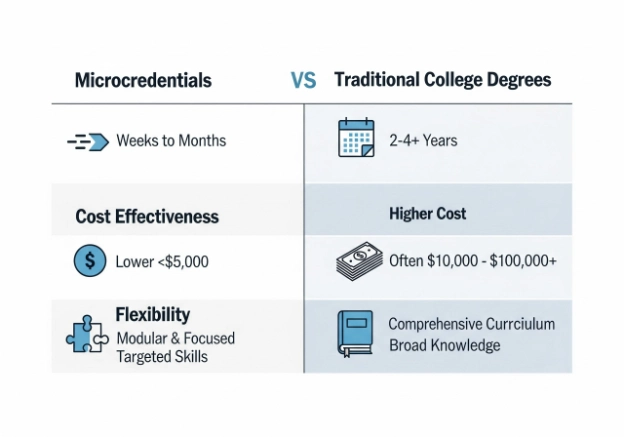
Microcredentials are more granular. They focus on one specific skill, tool, or competency. They are faster to earn, usually more affordable, and highly targeted to employers' needs right now. According to BCdiploma's 2026 analysis, a microcredential focuses on a specific skill or competency, whereas a certification tends to be broader and more established in its field.
The key insight: microcredentials and certificates are not competing. They are complementary. Many career builders use microcredentials to fill specific skill gaps quickly while working toward a larger certification over time.
Do Employers Care About Microcredentials in 2026?
Yes. And the data is striking.
According to Coursera's 2026 Micro-Credentials Impact Report, published in June 2026 and based on surveys across seven countries, 87% of graduates holding microcredentials reported securing a job aligned to their field within one year. An even more telling number: 83% of employed graduates say their microcredential played a significant factor in getting hired.
From the employer side, 92% of those surveyed reported that entry-level workers with microcredentials perform better in their first year on the job. And, as Inside Higher Ed's coverage of the report notes, 60% of employers said they would choose a less experienced candidate with a generative AI credential over a more experienced candidate without one.
The short answer: yes, employers absolutely care, and that care is growing.
The Skills-Based Hiring Shift and Why It Changes Everything
Here is the bigger picture. The entire framework of how companies hire is changing.
HR Executive reported on a February 2026 Brookings Institution analysis of more than 156 million U.S. resumes. The research found that the returns on non-degree credentials depend almost entirely on job relevance. A worker's first job-relevant credential is associated with a 3.8% wage premium, more than double the premium for a credential that does not closely match the role.
That word "relevant" is everything. Earning a microcredential in exactly the skill a job requires is worth more than earning a generic certificate in a related but less targeted area.
At the same time, HR Executive introduced a concept worth knowing: "credential fluency." It describes an organization's ability to identify and validate non-degree credentials as meaningful signals of job-relevant skills. In plain terms, more companies are getting better at recognizing microcredentials. The bias toward degree-only hiring is fading.

Best Microcredential Programs for Career Change in 2026
Whether you are switching industries or advancing within your current field, these are the most employer-recognized programs to consider.
Technology and AI
Google Career Certificates (Coursera) Google's certificates in data science, data analytics, project management, and cybersecurity are among the most widely recognized by employers. Fortune's coverage of Coursera CEO Greg Hart highlighted these specifically as standout programs that employers respond to. They are designed for people with no prior experience and take about six months to complete.
IBM Professional Certificates (Coursera) IBM offers a range of professional certificates in AI, data science, and cybersecurity. These are practical, skills-first programs that emphasize hands-on learning.
Google's Generative AI Courses (Coursera) With 60% of employers now prioritizing generative AI credentials, Google's Introduction to Generative AI and related courses are among the fastest ways to add a high-demand skill to your resume.
Business and Leadership
Salesforce Certifications: Salesforce has effectively built its own talent pipeline through career credentials. These are not just educational products; they signal to employers that you can operate their systems from day one.
LinkedIn Learning Certificates For professionals in leadership, communication, or management tracks, LinkedIn Learning offers hundreds of short programs that pair naturally with your work experience and sit directly on your public profile.
Stackable Microcredentials from Universities
The University of Hawaii launched new stackable microcredential programs in March 2026, specifically designed to bridge the gap between academic learning and workforce readiness. The concept of stacking is key: you earn smaller credentials over time, each building on the last, until you have a portfolio of verified skills that adds up to something bigger than any single degree.
Many community colleges and state universities are now offering this model, often at dramatically lower costs than traditional programs.
The Cost Comparison: Microcredentials vs Going Back to School
Let's be direct about the numbers.
A private four-year degree in the U.S. can cost $200,000 or more in tuition and lost income. A graduate degree adds tens of thousands on top of that.
Most microcredential programs cost between free and $500. Google and IBM certificates on Coursera, for example, run about $50 per month, and most can be completed within three to six months.
The economic argument for online learning and e-learning through microcredentials is straightforward. You spend less, learn faster, and can apply what you learn immediately without waiting for graduation.
What the Research Says About Salary Impact
The salary data is encouraging for microcredential earners.
Coursera's 2025 Micro-Credentials Impact Report found that nearly 9 in 10 employers are willing to offer a higher starting salary to candidates with recognized credentials, often 10 to 15% more. The 2026 follow-up report reinforces this, with 94% of employers indicating a willingness to pay more.
Entry-level workers with AI skills are seeing wage premiums of up to 25%, according to CNBC reporting from May 2026. Pairing a relevant microcredential with demonstrated soft skills puts you in the strongest possible position to negotiate.
Are Microcredentials Replacing College Degrees?
The honest answer is: not replacing, but competing.
Traditional degree programs are facing serious pressure. The cost of a private university education continues to outpace inflation, while the cost of digital upskilling has remained flat or even decreased due to AI-driven learning platforms. For younger workers and career changers, the case for spending four years in a classroom is harder to make than ever.
Inside Higher Ed's reporting on the June 2026 Coursera data describes a marketplace where employers are "increasingly prioritizing verified, job-relevant skills" over institutional pedigree. The shift is happening at the hiring level, not just in theory.
That said, degrees still matter for many roles. The smartest strategy is to combine your existing education with targeted microcredentials that signal current, relevant skills. A degree shows you can commit and think broadly. A microcredential shows you know what employers need right now.
How to Choose the Best Microcredential for Your Career Change
Follow this process before enrolling in any program.
Start with the job posting. Look at three to five listings for the role you want. Identify the tools, platforms, and skills mentioned most often. Choose a microcredential that directly addresses those specific requirements.
Check employer recognition. Programs from Google, IBM, Microsoft, Amazon, Salesforce, and Coursera-partnered universities carry the most weight with hiring managers. A credential from an unknown provider is harder to validate.
Think about stacking. If your goal is a career change, one microcredential probably will not do it alone. Plan a sequence. Start with a foundational credential, then add specialization credentials as you progress.
Factor in your timeline. Most microcredentials take four to twelve weeks at a few hours per week. If you are actively job searching, prioritize programs you can complete and add to your resume within 60 days.
FAQ: Microcredentials vs Certificates in 2026
What is the difference between a microcredential and a certificate? A certificate typically covers a broad subject area and may require a formal exam. A microcredential is more focused, targeting a specific skill or competency. Both are valuable, and many professionals pursue both over time.
Do employers actually look at microcredentials on a resume? Yes. Research from Coursera's 2026 report shows that 94% of employers are inclined to offer higher starting salaries to candidates with microcredentials, and 92% say workers with them perform better in their first year.
What are the best microcredential programs for a career change? The most employer-recognized programs in 2026 include Google Career Certificates, IBM Professional Certificates, and Microsoft Certifications, all available through Coursera and edX. Salesforce credentials are particularly valued in sales and CRM-focused roles.
How long does it take to earn a microcredential? Most programs take between four weeks and six months, depending on the depth of the curriculum and how many hours per week you dedicate. Many are self-paced, which means you can accelerate through them if your schedule allows.
Are microcredentials worth it if I already have a degree? Absolutely. A degree shows what you knew when you graduated. A microcredential shows what you know right now. Employers value both, and candidates who hold both often outperform those who have one without the other.
What is the difference between free and paid microcredentials? Free options are great for exploration and portfolio building. Paid credentials, especially those from recognized providers, carry more weight with employers. If budget is a concern, many platforms offer financial aid or free audit options.
Can microcredentials stack into something equivalent to a degree? Many universities and platforms are now designing stackable microcredential pathways that can be accumulated into a larger qualification. The University of Hawaii's 2026 program is one example. Over time, stacking can build a credential portfolio that rivals the practical career value of a traditional degree.
Ready to Build Skills That Get You Hired?
The job market in 2026 rewards people who can show what they know, not just what they studied years ago. Microcredentials are your fastest path from where you are to where you want to be.
Explore curated microcredential programs at scorethat.com and find the path that fits your goals, your budget, and your timeline. Whether you are looking to move up in your current role or pivot to something completely new, the right credential is out there. Start building today.
For more information on leveling up, look at:
Learning a new language to stand out
Sources consulted:
Coursera 2026 Micro-Credentials Impact Report via Inside Higher Ed (insidehighered.com/news/tech-innovation/alternative-credentials/2026/06/05/tough-job-market-microcredentials-give)
Fortune/Yahoo News on 2026 microcredential hiring trends, HR Executive on skills-based hiring execution gap (hrexecutive.com/new-research-reveals-the-execution-gap-in-skills-based-hiring/)
Brookings Institution 2026 resume analysis, CNBC hiring and AI skills data (cnbc.com/select/class-of-2026-hiring-stats-and-ai-trends/).